150,000 users were calling customer support just to figure out how to create an invoice. That number told us everything: the product wasn't just hard to use — it was fundamentally broken.
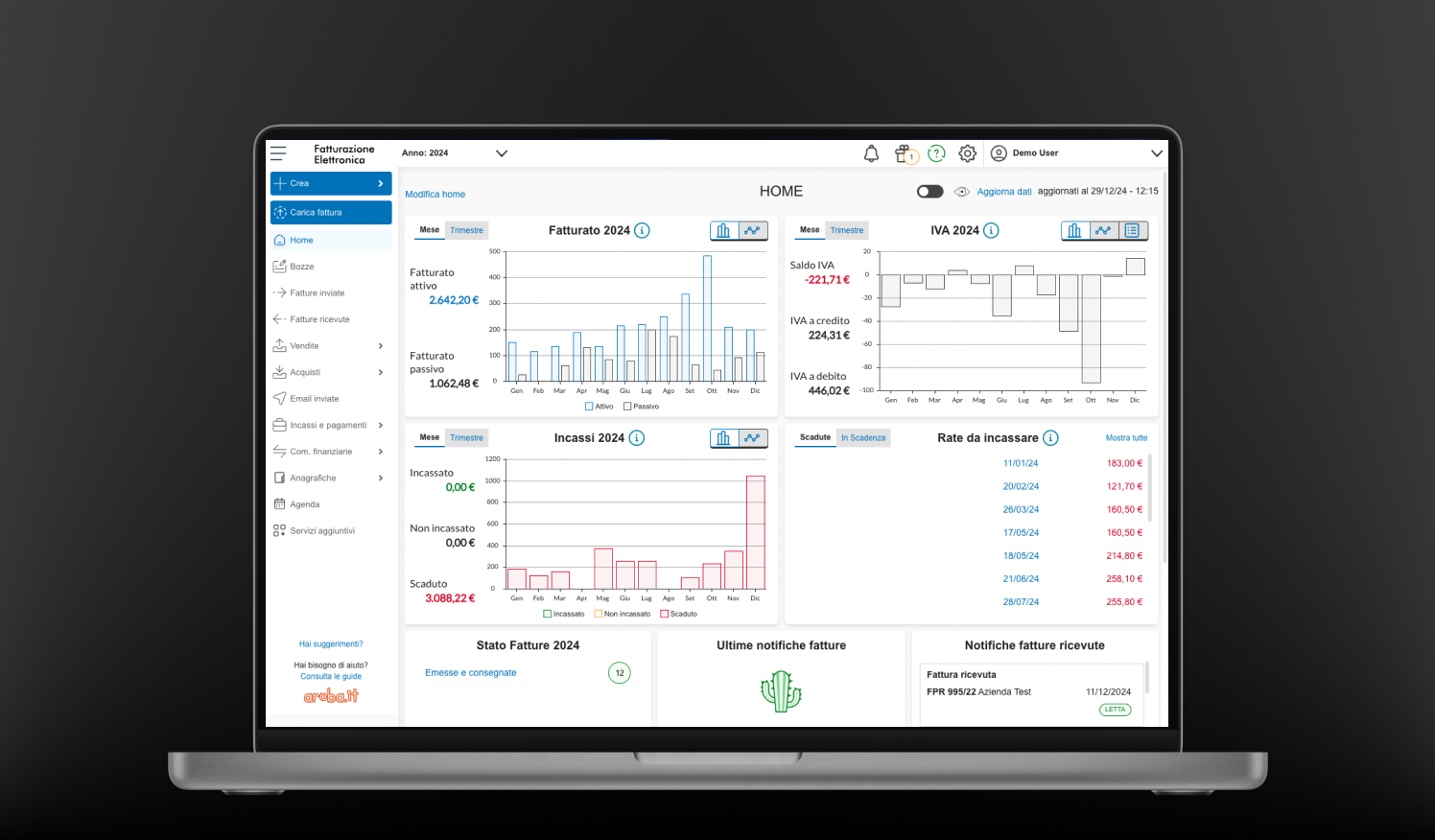
What started as a redesign to cut support costs has become one of Italy's most-used business platforms, now serving over one million paying users across desktop and mobile. The main design challenge wasn't just fixing what was broken — it was scaling the product to meet new regulatory requirements and expanding its capabilities without making it harder to use.
My role: Initially the sole product designer for the 6-month redesign — over the following years, I transitioned to Lead Designer, overseeing a team of multiple designers.
The Challenge
Aruba's e-invoicing software — used by small businesses and freelancers to invoice public administrations — was generating enormous support costs. Users couldn't figure out how to navigate it independently, which meant the company was spending heavily on support for tasks that should have been self-service.
The project manager handed me a brief and asked me to start designing. But with ~150,000 active users already relying on the product, I pushed back: shipping a redesign based on assumptions alone was too risky. I negotiated 6 weeks for user research before touching a single wireframe.
Aruba was known across Italy for competitive pricing. After this project, it would also be known for usability.
Research & Discovery
To understand real behavior — not just what users said they did — I combined four research methods:
●Database analysis Queried 150k live accounts to map real usage, abandonment points, and unused features.
●User survey Structured survey on active users to surface pain points without leading toward existing hypotheses.
●Competitor analysis Benchmarked Italian and international e-invoicing tools to understand usability standards users had already been exposed to.
●Form-filling research Reviewed academic and industry research on validation patterns and error prevention for high-stakes legal forms.
Insights
Terminology is a barrier
Users struggled with e-invoicing jargon — "SDI", "codice destinatario", "nota di variazione". Most had no accounting background and needed contextual guidance at the point of entry, not buried in a help section.
The IA was invisible
Invoice drafts were effectively lost inside the interface. Users created invoices, couldn't find them again, and called support to ask where they had gone.
⚠Errors came too late
Validation only triggered on form submission, forcing users to discover mistakes after filling a lengthy form. This caused repeated submissions and high frustration.
⊞Excel is the mental model
Most users managed invoices in spreadsheets before adopting this software. Table interactions — filtering, sorting, inline editing — were expected and completely absent.
The Idea & Exploration
The research pointed to two core problems: users couldn't find their way around the app, and they couldn't fill in invoices without making mistakes. I tackled both separately before combining them.
For the information architecture, I mapped out three alternative structures based on how different user types — freelancers, small business owners, accountants managing multiple clients — mentally organized their invoicing work. I sketched these as flows, not screens, and ran rapid validation sessions with stakeholders across sales, support, and product to pressure-test each direction before committing to wireframes.
For the invoice creation form, I explored several approaches to error prevention: inline validation, guided input with smart defaults, and a step-by-step wizard. The research on form-filling patterns strongly suggested that out-of-focus validation — flagging errors as soon as the user leaves a field — would outperform submit-time validation for this audience. I built wireframes in Adobe Illustrator and assembled interactive prototypes in InVision for stakeholder review and user testing.
Testing & Iteration
Testing followed a two-track process: internal sessions with the sales and support teams (who had the deepest knowledge of what users struggled with), followed by moderated usability testing with real users recruited from the existing customer base.
We ran three complete design–test–iterate cycles over 8 weeks. Each round surfaced specific issues we refined before moving to the next. The three rounds were structured around progressively higher-fidelity prototypes: paper sketches → interactive wireframes → near-final UI.
Testing Insights
Out-of-focus validation was immediately appreciated
Users noticed errors as they moved between fields. Several commented the form felt like it was "helping them" rather than waiting to catch them out.
The new IA removed the #1 support request
In every test session, users located their invoice drafts without assistance — the single task that had previously driven the most support calls.
Excel-style filters reduced cognitive load
Users oriented to the invoice list quickly using filters without prompting. One participant: "the first accounting software that doesn't feel like accounting software."
Tooltips replaced jargon
Contextual help embedded directly in form fields — explaining "codice destinatario" in plain language — eliminated confusion that had previously generated repeat support calls.
Results & Impact
Six months after launch, the results were clear — and they compounded over time.
-63%
Decrease in support contacts in the first 6 months post-launch, compared to the same period the previous year
1M+
Active paying users — a 614% increase since launch, accelerated by the Italian government extending mandatory e-invoicing to all companies
4.6
CSAT score for the most complex product of the company
"The primary reason for purchasing is its simplicity."
For a brand historically known only for competitive pricing, that shift was the clearest signal the redesign had worked. Following this success, we expanded the platform with 4 additional modules — expense management, document storage, deadlines tracking, and team collaboration — transforming it from an invoicing tool into a near-complete business management system. We continue to analyze user feedback daily, clustering it thematically to guide each quarterly roadmap.
 Terminology is a barrier
 The IA was invisible